



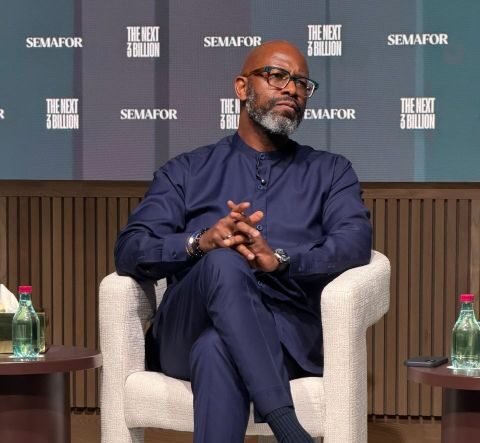
MTN Group has outlined plans to expand digital connectivity, financial services and infrastructure investment across Africa, as the telecommunications company seeks to turn growing access to technology into wider economic opportunities for individuals and businesses.
Speaking at SEMAFOR’s The Next 3 Billion event, MTN Group President and CEO Ralph Mupita said Africa needs greater investment in digital infrastructure, affordable connectivity and digital skills to ensure more people can participate in the digital economy.
Mupita highlighted a gap between the availability of broadband networks and actual digital participation across the continent. Although mobile technologies contributed approximately US$240 billion to Africa’s economy in 2025, nearly one billion people remain offline.
He identified affordability, access to devices, digital skills, relevant services and trust as major barriers preventing more Africans from benefiting from digital technologies.
According to Mupita, expanding network coverage alone will not be sufficient to achieve meaningful digital inclusion. He argued that greater attention must be given to how people use digital services, including payments, credit, remittances, insurance and e-commerce.
READ ALSO: AQURA SYSTEMS RAISES £2.1M TO ADVANCE AI-POWERED FISH FARM MONITORING TECHNOLOGY
To support this transition, MTN is pursuing its Ambition 2030 strategy, which focuses on three areas: connectivity, fintech and digital infrastructure.
Under the strategy, the company aims to add up to 70 million active data subscribers and connect up to 30 million additional homes. It also plans to expand its MoMo mobile money platform, which currently serves approximately 70 million monthly active users.
The expansion is expected to increase access to digital services and create opportunities for more people to participate in financial and commercial activities through mobile technology.
Beyond connectivity and financial services, Mupita emphasised the need for sustained investment in telecommunications infrastructure, particularly as demand for advanced technologies such as 5G and artificial intelligence (AI) increases.
He called for investment-led competition policies, arguing that market consolidation may be necessary to support the scale of investment required for 5G networks, fibre infrastructure and other technologies capable of supporting growing digital demand.
He also described low-earth-orbit satellite services as complementary to terrestrial networks, calling for consistent regulation across different connectivity technologies.
On AI development, Mupita said Africa needs local computing capacity, reliable connectivity, energy infrastructure and skilled workers to participate meaningfully in the emerging AI economy.
As part of its infrastructure ambitions, MTN is targeting a data-centre joint venture valued at between US$1 billion and US$2 billion. The company also plans to expand fibre corridors and generate more than R30 billion in AI-related value by 2030.
These investments form part of MTN’s broader ambition to strengthen the infrastructure required to support digital services and emerging technologies across its markets.
The strategy also highlights the importance of ensuring that infrastructure expansion is matched by affordable services, digital skills and accessible platforms. Without these elements, increased network availability may not translate into meaningful economic participation.
Mupita’s remarks underline the need for coordinated investment by telecommunications operators, governments and other industry stakeholders to address the barriers limiting digital participation across Africa.
For MTN, the next phase of its Ambition 2030 strategy will involve expanding its connectivity and fintech reach while investing in the infrastructure and capabilities needed to support Africa’s evolving digital economy.
