



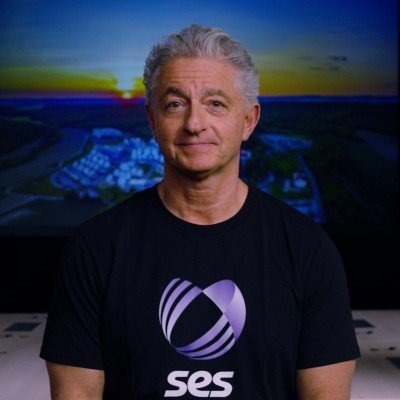
SES has deepened its strategic stake in Elveo Mobile, the direct-to-device operator that emerged this week from the completed merger of Lynk Global and Omnispace, strengthening SES’s position in the satellite race.
Announced on 17 August, the expanded partnership will see SES provide Elveo with access to its worldwide space and ground infrastructure, while backing the company’s efforts in go-to-market strategy, engineering, operations and regulatory matters. In exchange, SES’s mobile telecom, enterprise and government clients will gain multi-orbit connectivity through Elveo’s low-Earth orbit network, in addition to SES’s existing GEO and MEO satellite coverage.
SES chief executive Adel Al-Saleh called Elveo “an agile, forward-thinking innovator” and the right strategic partner for D2D services.
SES was already an investor in both companies before their merger closed on 14 August, and remains one of Elveo’s leading shareholde. This newly formed entity brings together Lynk’s low-Earth orbit smallsat constellation with Omnispace’s licensed mobile satellite spectrum, and it enters the market already backed by commercial agreements spanning more than 50 mobile network operators across over 60 countries, among them Spark in New Zealand, Globe Telecom in the Philippines and Vodafone Ghana.
The new entity combines Lynk’s low-Earth orbit smallsat network with Omnispace’s licensed mobile satellite spectrum, and arrives with commercial agreements already in place across more than 50 mobile network operators in over 60 countries, including Spark in New Zealand, Globe Telecom in the Philippines and Vodafone Ghana.
READ ALSO: TESLA LAUNCHES NEW CYBERCAB ROBOTAXI IN AUSTIN
This deepened partnership with Elveo comes on the heels of a robust start to the year for SES as a whole, after the company reported an 80% jump in first quarter revenue, a surge that was driven largely by growth in aviation connectivity rather than D2D services. This pattern underscores how much of SES’s current business momentum is still being generated outside the mobile satellite category that it is now investing heavily to build.
Prior to the merger, Omnispace’s own direct-to-device ambitions had been stalled after the company reported that its operations were experiencing interference from SpaceX’s competing direct-to-device services in the US market. By folding that spectrum and underlying technology into a newly combined entity, one backed by a satellite operator that already operates its own GEO and MEO fleets, Elveo has been given a stronger foundation from which to contest a market that SpaceX has so far led in developing.
Direct-to-device (D2D) connectivity works by beaming coverage directly to unmodified smartphones without relying on traditional ground infrastructure, and until now it has largely been framed as a two-way contest between SpaceX’s Starlink, which partners with T-Mobile in the US, and AST SpaceMobile, which works with both AT&T and Verizon. With Elveo’s relaunch now backed by SES’s multi-orbit infrastructure, a third serious contender has emerged, one that has been built specifically to challenge both incumbents on scale and technical breadth.
This existing rivalry between the two dominant players is already unfolding well beyond the borders of the US, as Ookla data published earlier this year revealed that the UK became the third-largest D2D market globally within just weeks of Virgin Media O2 launching its Starlink-powered service. Meanwhile, VodafoneThree is preparing to roll out a competing AST SpaceMobile service later in the year, a development that signals how rapidly the two incumbents are exporting their rivalry into new international markets, and it illustrates the scale that Elveo will need to match if it hopes to compete effectively.
What distinguishes Elveo’s pitch from its rivals is its emphasis on multi-orbit integration, since SpaceX and AST SpaceMobile have both focused on building single-constellation networks confined to low-Earth orbit. In contrast, Elveo combines its own LEO satellites with SES’s already established GEO and MEO fleets, an architecture that the companies jointly describe as the first fully integrated, cost-effective multi-orbit solution built for direct-to-device connectivity. Whether this combined approach will ultimately prove commercially or technically superior to a pure-LEO strategy remains unproven, but it does give Elveo a distinct value proposition to offer, rather than one that competes purely on the size of its constellation.
Elveo also enters the market with distribution channels already established, a direct legacy of Lynk’s pre-existing relationships with mobile network operators, meaning it will not need to build these partnerships from scratch as an entirely new entrant would. This existing infrastructure gives Elveo a considerably faster route to generating revenue than a newcomer might otherwise expect, even as the company continues working to scale its satellite fleet and prove that its technology can perform reliably at volume.
