



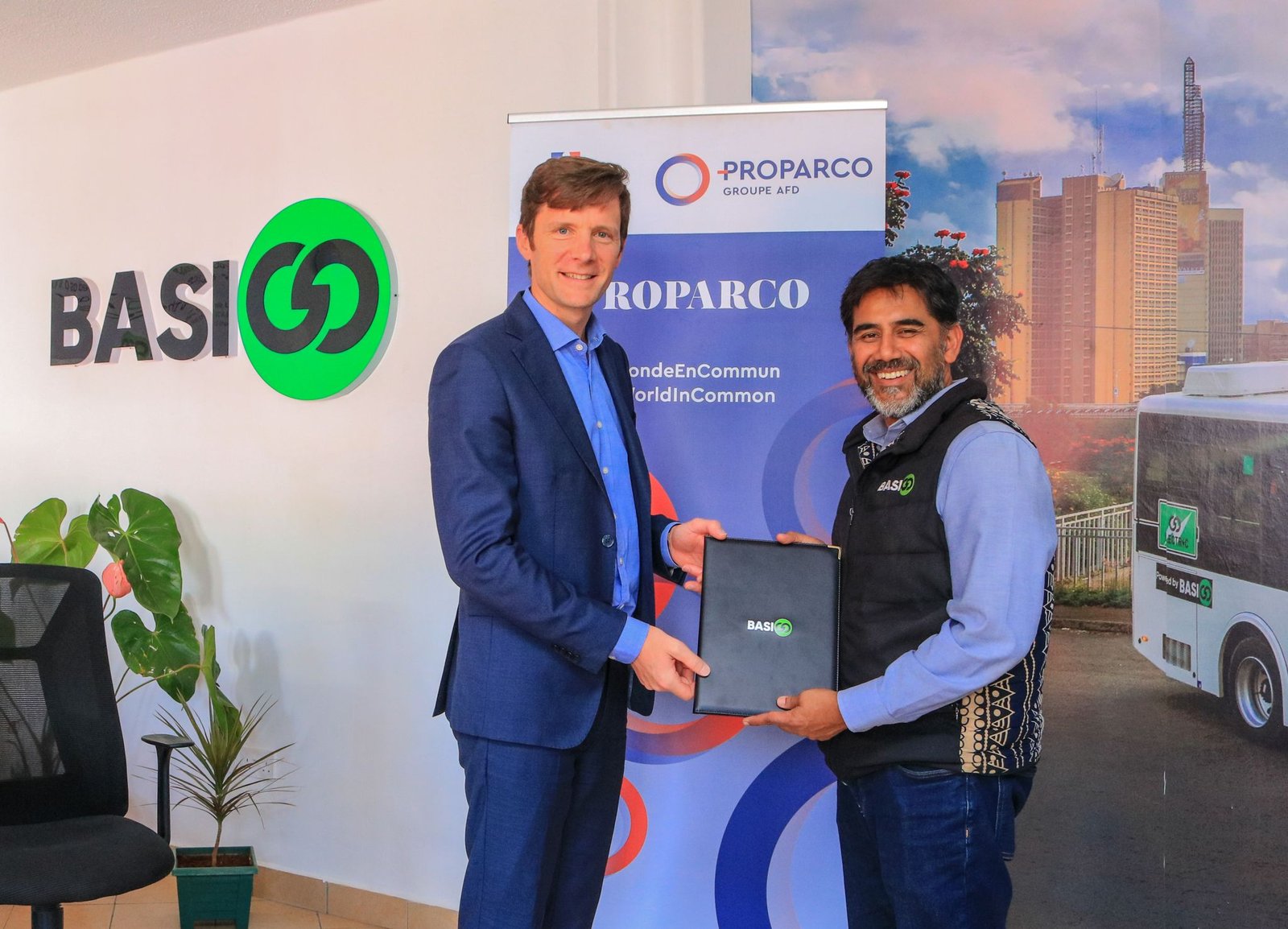
French development financier Proparco has sealed a major new investment in Nairobi-based e-mobility pioneer BasiGo, supercharging the start-up’s mission to replace diesel buses with locally assembled electric ones across East Africa and beyond.
The funding will fuel BasiGo’s ambitious “Road to 1000” target, expanding local assembly lines, rolling out more charging stations, and deepening its Pay-As-You-Drive model that already saves public transport operators up to 40% in annual running costs.
Since launching in 2021, BasiGo has deployed more than 100 electric buses in Kenya and Rwanda, clocking over 1.5 million clean kilometres and carrying more than 9 million passengers. Each electric bus eliminates 50–90% of the CO₂ emissions of its diesel equivalent, avoiding more than 3,000 tonnes of CO₂e to date while cutting deadly urban air pollution.
Twenty-nine transport saccos now operate BasiGo buses, benefiting from lower fuel and maintenance bills and safer, quieter vehicles for commuters.
ALSO READ: LOOP DFS APPOINTS BRYAN KARIUKI AS CHIEF PRODUCT OFFICER
Jean Guyonnet-Dupérat, Proparco’s Regional Director for East Africa, hailed the partnership: “By backing BasiGo we are unlocking a new generation of clean, reliable mass transit for tens of thousands of daily passengers in Kenya and Rwanda — and proving this model can scale to other African cities. Locally built electric buses create quality jobs, slash emissions, and improve public health — exactly what the Paris Agreement and our Choose Africa initiative are about.”
BasiGo CEO and Co-Founder Jit Bhattacharya welcomed the capital injection as a ringing endorsement of the company’s proven economics: “Proparco’s investment validates what we’ve demonstrated since day one: electric buses are cheaper to run than diesel, better for the planet, and deliver a smoother ride for passengers. This funding accelerates everything — more local assembly, bigger charging networks, and faster progress toward 1,000 electric buses on African roads.”
With the new funds, BasiGo is poised to deepen its footprint in Kenya and Rwanda while preparing to enter additional African markets, cementing its position as the continent’s leading electric public-transport platform
