











Kenya’s ICT Authority (ICTA) has launched an international tender to expand the country’s national fibre-optic backbone and improve cross-border and metropolitan connectivity. The project is being implemented under the World Bank-supported Kenya Digital Economy Acceleration Project.
The procurement notice, identified as KE-ICTA-538567-NC-RFB, is divided into two lots. Lot 1 covers the expansion of National Backbone Links, while Lot 2 focuses on Cross-Border and Metro Links. Both framework agreements will initially run for three years, with the possibility of extensions of up to two additional years.
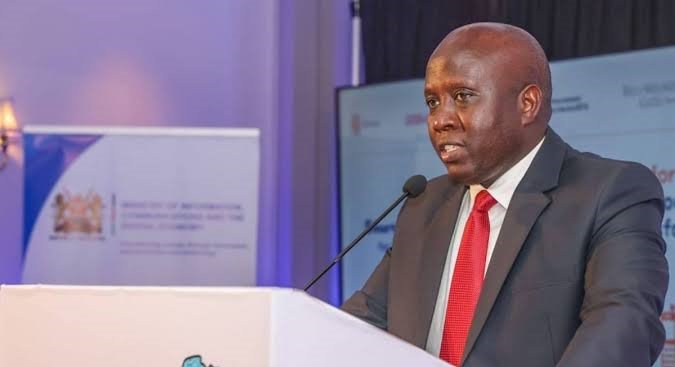
“This investment will strengthen the resilience and redundancy of our national infrastructure,” said Eng. John Tanui, principal secretary at the Ministry of Information, Communications and the Digital Economy.
Tanui said the fibre expansion would bring more public institutions onto the network, improve access to affordable connectivity and create opportunities for private operators to extend last-mile services to millions of households and businesses. He also encouraged qualified local and international infrastructure companies to participate in the procurement process.
READ ALSO: CYBASTION TO MOBILISE $300M FOR SENEGAL’S DIGITAL TRANSFORMATION
The tender comes as the Kenyan government works towards its target of deploying 100,000 kilometres of national fibre-optic cable before the 2027 general election. Treasury data shows that Kenya’s public-sector fibre network had reached 30,454km at the latest count, compared with 22,486km in 2022 when President William Ruto assumed office.
The latest tender forms part of the government’s wider fibre rollout programme and is intended to expand the infrastructure needed to support wider digital connectivity across Kenya.
The project is being financed through World Bank loan and credit facilities 7289-KE and 7290-KE, with procurement being conducted under the World Bank’s international competitive procurement framework.
ICTA will operate the framework agreements as the sole contracting authority, while multiple service providers may be selected under each lot. Individual projects will subsequently be awarded through a secondary procurement process, meaning signing a framework agreement does not automatically guarantee a provider a specific contract.
Bids will place greater emphasis on technical capability and other non-price factors, which will account for 80% of the evaluation, while cost will carry a 20% weighting. Successful bidders will also be required to provide beneficial ownership information as part of the World Bank’s transparency requirements.
The fibre expansion is expected to strengthen Kenya’s national connectivity infrastructure while supporting public-sector digital services, private-sector broadband deployment and wider access to digital opportunities across the country.